
You're Not Building AI Servers — So Why Is Your BOM Getting Squeezed?
The Physics and Economics Behind the High-Cap MLCC Shortage, and What Hardware Startups Should Do About It
SOURCING & SUPPLY CHAIN
JoeZ
7/7/20266 min read
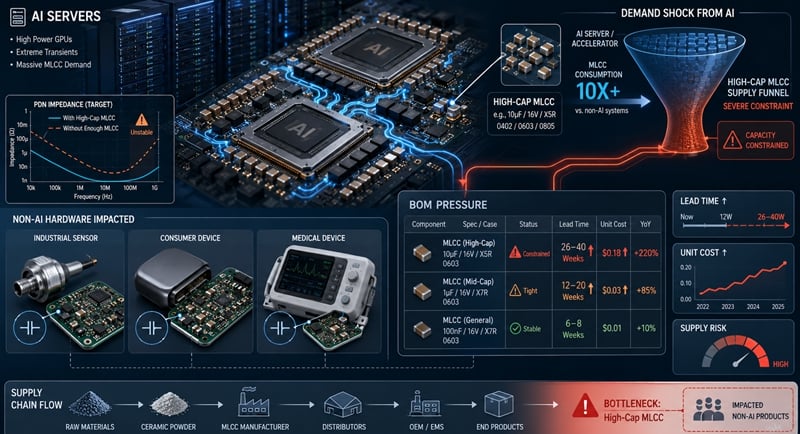
If you build hardware for a living, you've probably felt it already: a routine reorder for a capacitor that cost pennies last year comes back with a 20-plus-week lead time and a double-digit price increase. Your product has nothing to do with AI. You're building an industrial sensor, a consumer gadget, a medical device. So why is your bill of materials suddenly collateral damage in someone else's arms race?
Here's the short answer: AI data centers are consuming high-capacitance MLCCs faster than the world can make them, and the reasons are rooted in physics, not hype. Understanding why AI chips need these specific parts — and why nothing else can substitute for them — will tell you exactly how long this squeeze will last and what to do about it.
One important clarification before we start: this is not a general MLCC shortage. Low-capacitance commodity parts remain readily available, and in some segments are actually oversupplied. The crunch is concentrated in high-capacitance MLCCs — roughly 10µF and above — especially in the case sizes used in power delivery networks. If your design leans on those parts, keep reading.
The Physics: Why AI Chips Are Capacitor Gluttons
An AI accelerator has a load profile unlike anything else in electronics. One microsecond, the chip is idle, drawing a few amps. The next microsecond, the tensor cores — the compute units that occupy most of the die area — slam to full load, and current demand swings to thousands of amps.
No switching power supply on earth can respond to a transient that fast. The voltage regulator simply cannot slew quickly enough. The only thing standing between that current spike and a catastrophic voltage droop is the array of MLCCs mounted directly on the back of the chip package. Those capacitors act as local energy reservoirs, supplying the instantaneous current until the regulator catches up.
Why voltage droop is unacceptable for AI
Modern processors run frequency and voltage in lockstep — higher voltage enables higher clock frequency, which is exactly how GPU boost modes work. But the relationship cuts both ways. If a chip is running at 1 GHz on a 1 V rail and that rail sags during a transient, the logic can no longer complete its operations within the clock period. The chip computes wrong answers. The alternative is to downclock and sacrifice performance — which defeats the entire purpose of an AI accelerator, where performance is the product.
This is why AI silicon has far stricter power-delivery noise requirements than consumer chips, and why the industry frames the problem in terms of PDN (power delivery network) impedance. Whichever capacitor solution presents the lowest impedance across the relevant frequency band produces the least voltage noise for a given current transient. High-capacitance MLCCs deliver lower PDN impedance than low-capacitance parts across essentially the entire spectrum. For the backside of an AI chip, high-cap MLCCs aren't a preference — they're the only viable answer.
Why substitutes can't rescue supply
The obvious question: why not use polymer capacitors? They offer large bulk capacitance with minimal DC bias derating — a big reservoir, on paper.
The problem is parasitics. Polymer capacitors carry higher equivalent series inductance and resistance than MLCCs, which limits the frequency range they can service. The rigorous comparison is always PDN impedance: whichever part achieves lower impedance wins, and the vast majority of polymer capacitors simply cannot match MLCC impedance levels. Meanwhile, MLCC technology keeps advancing — today's high-cap MLCCs can exceed polymer capacitors in effective capacitance at the same board footprint. Their only drawback is cost, and cost is not a constraint for hyperscalers.
The market is proving this out in real time. Next-generation AI platforms are actively stripping aluminum electrolytic and tantalum capacitors out of their designs and replacing them with MLCCs — in some cases multiplying per-board MLCC counts several times over. Demand isn't just growing; it's concentrating onto exactly one component family.
The Economics: Four Forces Driving the Super-Cycle
The physics explains why demand exists. Four converging forces explain why it's overwhelming supply.
1. Explosive AI compute buildout
The numbers are staggering. A single 8-GPU AI training server consumes roughly 48,000 high-end MLCCs. A flagship rack-scale AI system uses more than 440,000 — over nine times the count of a conventional server. Global MLCC demand from AI servers is projected to grow 87% year over year in 2026, and industry forecasts suggest AI-driven demand could triple again within two to three years. Every major cloud provider is ramping custom accelerator platforms simultaneously, all pulling on the same handful of tier-one suppliers.
2. EVs are competing for the same capacity
Electric vehicles are the second jaw of the vise. A conventional combustion car uses about 3,000 MLCCs; a battery-electric vehicle needs around 18,000 — six times as many. With global NEV sales forecast to reach 23 million units in 2026 and the industry migrating to 800 V high-voltage platforms, per-vehicle passive component counts keep climbing. Automotive-grade parts carry high certification barriers and long qualification cycles, so this capacity can't flex quickly. And as Japanese and Korean leaders tilt their lines toward high-margin AI products, general-purpose capacity gets squeezed from both directions.
3. Raw material costs are surging
Silver — a core electrode material — has risen more than 140% in a year, and palladium and ruthenium have climbed alongside it. Industry estimates put the resulting increase in passive component production costs at 20–30%. Layer on elevated energy prices, geopolitical risk, and volatile international freight rates, and manufacturers face genuine cost pressure that flows straight into price letters.
4. Market psychology is amplifying everything
Price-increase notices collided with rumors of suppliers pausing new orders, and sentiment ignited. Distributors receiving reduced allocations began precautionary stockpiling, which tightened an already short market further. At points, the spot market has seen inventory locked away and quoting suspended entirely — classic shortage-cycle behavior that turns tight supply into no supply.
Why Supply Can't Catch Up Before 2027
Here's the structural problem: MLCC manufacturing equipment carries ordering cycles of two to three years. Even a supplier who decided to expand aggressively today wouldn't ship meaningful new capacity until well into 2027 or 2028. The high-end products AI servers require are also extraordinarily difficult to manufacture at yield, which limits how much effective output new lines add even once built.
Existing capacity was simply never planned with AI in mind. Suppliers are responding — capex announcements and new plants are in motion — but announced expansion rates of 10–15% per year cannot bridge a demand curve that is roughly doubling annually in the AI segment. The industry consensus is increasingly that this isn't a spike; it's a super-cycle — longer in duration and broader in reach than the 2018 or 2021 shortages.
What This Means for Hardware Startups
If you're a hardware startup or small OEM, you're at the back of the allocation line behind hyperscalers and automotive tier-ones. That's the bad news. The good news: most of your exposure can be engineered away — if you address it early. Here's the playbook we recommend to our NPI clients:
Audit your BOM for high-risk parts now. Flag anything at 10µF and above, high-cap X5R/X6S dielectrics, and the case sizes concentrated in power stages. These are the parts where lead times have stretched from 8 weeks to 20-plus and spot prices have jumped 50% or more.
Design in flexibility at the NPI stage. Dual-footprint pads, pre-qualified alternate dielectrics, and multi-vendor approvals cost almost nothing during layout. A board respin to accommodate a different capacitor footprint mid-production costs months and real money.
Rethink just-in-time. For high-risk parts, move toward allocation agreements and strategic buffer stock. With further price increases expected on high-end parts through the second half of 2026, waiting for the market to stabilize is itself a bet — and not a good one.
Use bulk capacitance intelligently. Not every rail in your design faces AI-class transients. In many applications, a well-analyzed mix of polymer or tantalum bulk capacitance plus a smaller count of MLCCs for high-frequency decoupling can reduce your exposure to the scarcest parts — as long as the PDN impedance targets are verified, not assumed.
The Bottom Line
The high-cap MLCC shortage isn't a temporary glitch — it's the collision of physics (AI chips genuinely cannot function without these parts) with economics (capacity that takes years to build meets demand that doubles annually). For hardware companies outside the AI sector, the cheapest insurance is designing supply-chain resilience into your product from the very first prototype.
That's exactly where we work. At Peakingtech, our NPI process includes BOM risk analysis, alternate component qualification, and sourcing strategy as standard practice — because a great product that can't ship isn't a great product. If you're planning a new build or worried about the parts already on your board, talk to our team before the next price letter lands.
SERVICES
Peakingtech © 2025. · Shenzhen, China · Privacy Policy · Terms of Service
Contact Form
Metal Parts


Peakingtech® is a registered trademark of Peakingtech Co in the United States.
COMPANY
CONTACT