Electronics Manufacturing for Startups and Growing Hardware Brands
SMT assembly, PCBA, functional testing, and box-build from our Shenzhen facility — prototype quantities to production runs, with NPI support built in.
Services › Electronics Manufacturing
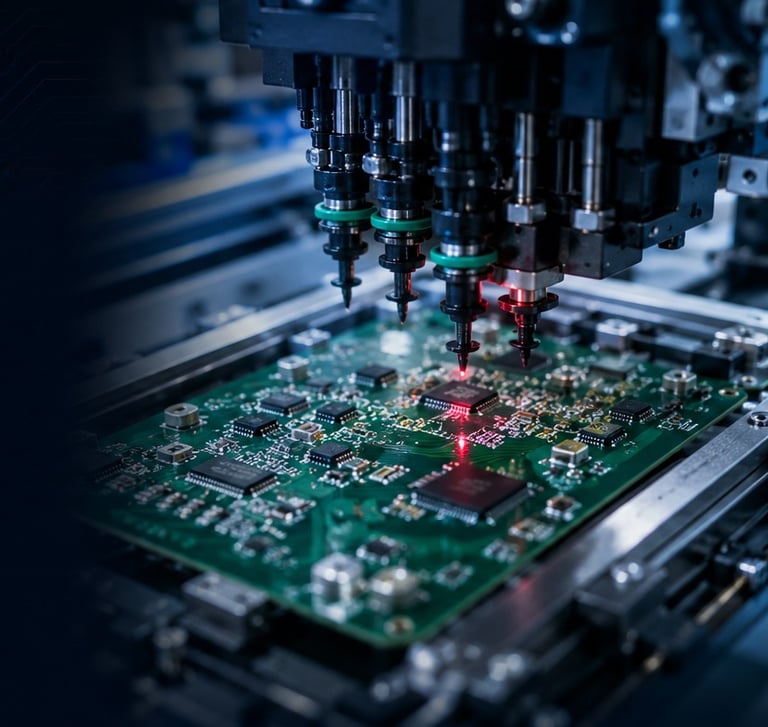
CONTRACT MANUFACTURING · SHENZHEN
SMT Assembly
Through-Hole
PCBA Turnkey
Box-Build
AOI Inspection
Functional Testing
WHO WE MANUFACTURE FOR
Built for startups and growing brands — not just large OEMs
Whether you're building your first batch of 50 units or scaling to monthly runs of 5,000 — we structure our process around your volume, your timeline, and your quality requirements.
You have a validated prototype and need your first real build
First CM engagement · Prototype to pilot run
TYPICAL SITUATION
HARDWARE STARTUP
Your breadboard or assembled prototype works. You've validated the concept and you're ready to move beyond hand-built units. You need a CM who will take a small first order seriously and help you build a process for scale.
Whichever stage you're at, our manufacturing process is the same — IPC-A-610 Class 2, full AOI inspection, documented first articles, and proactive communication throughout. The difference is the scale we calibrate it to.
WHAT THEY BRING
Gerber files and BOM (sometimes incomplete or from another engineer)
A working prototype for reference
A target quantity usually between 50 and 500 units
A timeline driven by a launch date or investor milestone
WHAT THEY NEED FROM US
DFM review before first build
Turnkey component sourcing
Small-batch SMT assembly
Functional testing against their test protocol
Clear documentation for repeat orders
PRODUCT BRAND
You have a proven product and need a reliable production partner
Ongoing production · Supplier evaluation or switch
See our NPI process ->
TYPICAL SITUATION
Your product is in the market and selling. Your current manufacturer has quality issues, communication problems, or can't scale with you. Or you're bringing manufacturing in-house for the first time after using a distributor. You need consistent, predictable production.
WHAT THEY BRING
Complete, approved design files
An established BOM with preferred suppliers
An existing test protocol or quality specification
Monthly volume requirements and forecast
Quality history data from their current manufacturer
WHAT THEY NEED FROM US
Consistent quality across production runs
Competitive pricing at their volume tier
Proactive communication — not chasing for updates
First article qualification against their existing spec
Smooth transition from their current supplier
See our quality system ->
OEM / PRODUCT MANAGER
You have complete engineering specs and need precise execution
Technical procurement · Spec-driven manufacturing
TYPICAL SITUATION
You're a product manager, hardware engineer, or procurement lead at a company that designs internally. You have a complete engineering package and you need a CM that executes to spec without improvising. Your job is on the line if quality fails or timelines slip.
WHAT THEY BRING
Complete Gerber and assembly files
Approved BOM with AVL (Approved Vendor List)
Written quality specification and IPC class requirement
Functional test protocol and acceptance criteria
Target pricing from current supplier for comparison
WHAT THEY NEED FROM US
Exact compliance with their engineering specification
Component sourcing from their AVL or approved equivalent substitutes only
IPC-A-610 Class 2 or Class 3 inspection as specified
Detailed production records and traceability documentation
On-time delivery to agreed schedule — no surprises
See our capabilities ->
See our full manufacturing capabilities →
CAPABILITIES
What our production line can build
Six core manufacturing capabilities — from bare PCB procurement through to fully assembled, tested, and packaged products. Here's exactly what each covers.
PCB Manufacturing


High-quality bare PCBs with fast lead times and multiple options.
Substrate: FR4, metal, polyimide, etc.
Layer count: 1-20 layers
Min. line/space: 3/3 mil (75/75 µm)
Surface finish: HASL, ENIG, OSP


SMT Assembly
Precision SMT assembly for a wide range of components.
Component size: 0201 metric and above
BGA pitch: 0.35mm and above
Placement accuracy: ±25 μm (3σ)
Dimensions: 50×50mm ~ 460×510mm


THT Assembly
Reliable through-hole assembly with wave or selective soldering.
Hole size: 0.6mm and above
Component lead: Axial, radial, connectors
Wave solder: Dual wave with N2 protection
Hand soldering: For odd-form, heat-sensitive, and rework


Testing & Inspection
Comprehensive testing to ensure quality and reliability.
100% AOI inspection
X-ray inspection for BGA, QFN, voiding
ICT, functional test, and boundary scan
Burn-in testing for duration


Final Assembly
Product assembly, integration, and system level build.
Box build and system integration
Cable assembly and harness
Conformal coating, potting, and labeling
Enclosure integration - Plastic, metal, and custom enclosures


Packaging & Fulfillment
Secure packaging, kitting, and global shipment support.
ESD-safe packaging and protection
Kitting, labeling, and user manuals
Global shipping with tracked logistics
Amazon prep - FNSKU labeling, poly bag, carton pack
Need something specific? If you don't see a capability you require, let us know. We build custom solutions.
Talk to our manufacturing experts →
OUR NPI PROCESS
How we turn your design files into a manufactured product
Six defined steps from file review to production-ready approval — with a quality gate and client checkpoint at every stage. Nothing moves forward without your sign-off.
01
File Review & DFM Check
1-2 days
We review your files in detail.
Our engineering team performs DFM analysis on your Gerbers, BOM and assembly drawings to identify risks and optimize for manufacturability.


Engineering review completed
DELIVERABLES
DFM report & feedback
Risk & issue list
Recommended actions
QUALITY GATE
CLIENT CHECKPOINT
Approve DFM or request changes
02
Quote & Plan Confirmation
1 day


We provide a clear quote & build plan.
You receive transparent pricing, estimated timeline, and a build plan with supply chain and resource allocation.
DELIVERABLES
Detailed quotation
Build plan & timeline
Supply chain plan
QUALITY GATE
Quotation & plan reviewed internally
CLIENT CHECKPOINT
Approve quote and build plan
03
Component Sourcing & Kitting
2-5 days


We source components & prepare your kit.
We source components from trusted suppliers and prepare kitted materials with full traceability before production.
DELIVERABLES
Component traceability report
Kitting list & photos
Material readiness report
QUALITY GATE
Approve kitted materials to proceed
CLIENT CHECKPOINT
Incoming inspection & verification
04
First Article Build
3-5 days


We build your first article sample.
Our SMT and THT lines assemble the first article build exactly to your specifications and process requirements.
DELIVERABLES


First article build (FAI)
Assembly records
FAI test results
QUALITY GATE
In-line QC & process verification
CLIENT CHECKPOINT
Review and approve first article
Test & Quality Validation
05
2-3 days
We test and validate to your standards.
Comprehensive testing and inspection ensure the build meets all function, quality, and reliability requirements.
DELIVERABLES
Functional test report
AOI, X-ray & ICT results
Quality inspection report
QUALITY GATE
All tests passed & reports reviewed
CLIENT CHECKPOINT
Approve for production release
06
Production Release & Handover
1-2 days
We release to production.
Upon approval, we ramp up production with the same pprocess, quality controls, and communication throughout.
DELIVERABLES
Production units
Final test report
Shipping & documents
QUALITY GATE
Production readiness confirmed
CLIENT CHECKPOINT
Final sign-off to ship


Total NPI Timeline: 10-18 working days
Timeline depends on component availability, complexity, and client response time. We keep you informed at every step.
Request a Timeline Estimate ->
Ready to start your NPI build? Let's turn your design into a product.
SUPPLY MODELS
Turnkey, consignment, or partial — we support all three
The supply model determines who sources your components and how pricing is structured. Understanding the difference helps you choose the right approach for your project — and helps us quote accurately from the start.
Turnkey Manufacturing
You provide files. We source everything, build everything, and deliver finished boards.


WHO DOES WHAT
You provide Gerber files, BOM, and assembly drawings. We source all components, procure the PCB, and manage the complete build — component ordering, incoming inspection, kitting, assembly, test, and shipping.
BEST FOR
Hardware startups and founders without existing supply chain relationships. Products where Shenzhen market sourcing delivers the best combination of price and availability. First production runs where the client wants to minimize operational complexity.
PRICING STRUCTURE
Assembly cost + component cost + sourcing fee. Component cost is quoted separately from assembly — you receive a line-by-line BOM cost breakdown before we order anything. No hidden margins.
TYPICAL SCENARIO
A hardware startup with a validated prototype sends us their design files. We review, quote the complete build cost including components, and manage everything through to delivered boards. The client's only job is to review DFM, approve the BOM cost, and accept delivery.
Choose this if...:
You don't have existing component supplier relationships, you want to minimize procurement complexity, or you want Shenzhen market pricing without managing a supply chain yourself.




Partial Consignment
You supply specific components. We source everything else and manage the complete build.
WHO DOES WHAT
You supply the components that matter most to you — proprietary parts, specific supplier-qualified components, long-lead-time items, or anything where you need direct supply chain control. We source all remaining components at Shenzhen market pricing.
BEST FOR
Established brands with existing supplier relationships for key components. Products with proprietary or custom parts that can't be open-market sourced. Projects where some components have strategic supplier qualifications or regulatory traceability requirements.
PRICING STRUCTURE
Assembly cost + our sourcing cost for non-supplied components + kitting and incoming inspection for your supplied components. Your supplied components are not marked up — you own them. We charge a small incoming inspection and kitting fee per component line.
TYPICAL SCENARIO
A product brand supplies their custom display module and a specific PMIC from their qualified supplier. We source all standard passive components, connectors, and ICs from Shenzhen. The client controls the supply of their two most important components while benefiting from our procurement efficiency for the rest.
Choose this if...:
You have specific supplier relationships for key components, you have proprietary or custom parts that must come from a specific source, or you want a balance of supply chain control and procurement convenience.
Full Consignment
You supply all components. We provide assembly, test, and inspection only.
WHO DOES WHAT
You source and supply every component on the BOM — PCB, all SMT and through-hole components, any hardware. We provide the assembly service only — line setup, SMT placement, soldering, AOI, functional test, and packaging. We do not source any components on your behalf.
BEST FOR
Established OEMs and product companies with mature supply chain relationships. Products with strict AVL requirements where all components must come from specific qualified suppliers. High-volume production where the client negotiates direct component pricing. Companies with existing inventory they need assembled.
PRICING STRUCTURE
Assembly cost only. No component procurement, no sourcing fees. Pricing is based on board complexity, component count, and volume. You bear all component procurement risk — shortages or quality failures in your supplied components are your responsibility to resolve.
TYPICAL SCENARIO
A product manager at an established electronics brand has existing supplier agreements for all components and a mature BOM. Their preferred assembly partner in Europe has capacity issues. They ship kitted components to our Shenzhen facility — we assemble, test, and ship finished boards back to their distribution center.
Choose this if...:
You have established supply chain relationships for all components, your components must come from specific qualified suppliers, you have existing component inventory to be assembled, or you want assembly-only pricing with no sourcing involvement from us.
Not sure which model is right for you? Simply answer 3 questions
Do you have existing supplier relationships for your components?
Are any of your components custom, proprietary, or from a specific required supplier?
What's your approximate order quantity?


Get a quote for your preferred supply model →
QUALITY & COMPLIANCE
Built to IPC standards with full production traceability
Every build runs through a defined quality system — inspection at every stage, documented results per unit, and compliance with the standards your product needs to reach market. Here's exactly what that looks like.
OUR QUALITY SYSTEM
ASSEMBLY ACCEPTABILITY STANDARD
IPC-A-610 Class 2
IPC-A-610 is the globally recognized standard for the acceptability of electronic assemblies. Class 2 covers general electronics products — the standard applied to the vast majority of consumer, commercial, and industrial electronics. It defines acceptance criteria for solder joints, component placement, cleanliness, and cosmetic condition.


SOLDERING STANDARD
IPC J-STD-001
IPC J-STD-001 defines the requirements for soldering electrical and electronic assemblies — covering materials, methods, and verification criteria for both lead-free and leaded solder processes. Our processes are qualified to J-STD-001 Class 2, with Class 3 available alongside IPC-A-610 Class 3 for high-reliability builds.


PCB FABRICATION STANDARD
IPC-6012 Class 2
IPC-6012 covers the qualification and performance specification for rigid PCBs. Class 2 is the standard for general electronics. We verify PCB incoming quality against IPC-6012 before any boards enter the assembly process — incoming inspection is not optional.


REWORK & REPAIR STANDARD
IPC-7711/7721
Rework and repair — when required — is performed to IPC-7711/7721 standards. All rework is documented with the reason, the method used, and the technician responsible. Reworked units are retested to the same functional test protocol as original builds. Rework is never hidden — it appears in the build record for every unit.
CERTIFICATIONS & COMPLIANCE
RoHS 2.0 & 3
Fully compliant with RoHS 2.0 (2011/65/EU) and RoHS 3.0 (2015/863/EU) for all restricted substances.


ISO 9001:2015
Certified Quality Management System ensuring consistent process control and continuous improvement.


EPA-compliant ESD control program across all production and inspection areas.
ESD Protected


All materials and processes coomply with REACH regulation (EC) No. 1907/2006.
REACH Compliant


Active member of IPC - advancing standards and best practices in electronics manufacturing.
IPC Member

UL recognization for printed wiring board (File E486494) and assemblies.
UL Recognition




INSPECTION AT EVERY STAGE


Incoming Inspection
All components and PCBs inspected before use.
100% AOI inspection after SMT placement.
Post-SMT AOI


Electrical test of every board for assembly accuracy.
In-Circuit Test (ICT)


For BGA, QFN and hidden joints as required.
X-Ray Inspection


Functional testing to your approved test protocol.
Functional Test


Final visual inspection and packaging verification.
Fina Inspection


Quality you can count on. Documentation you can trust.
Request Quality Documentation ->
Realistic numbers — no surprises
Minimum quantities, lead times, and pricing structure across three production stages — so you know what to expect before you reach out. Exact pricing requires a BOM and Gerber files; what's shown here is the framework.
MINIMUMS & LEAD TIMES
Prototype Build
First article and functional prototypes
Typical minimum quantity 10-50 units
Typical lead time 2-4 weeks
For initial validation and testing
Turnkey or consignment supply
Engineering support included
Best for: First builds, investor demos, design validation
Best for: Market testing, early sales, pilot programs
Bridge from prototype to full production
Process optimization and yield stability
Cost-effective for small volumes
Small-batch production and marketing testing
Typical minimum quantity 100-500 units
Typical lead time 4-6 weeks
Pilot Run
Best for: Full-scale production, ongoing supply
Stable demand and repeat orders
Best pricing at scale
Long-term supply reliability
Volume production at scale
Typical minimum quantity 1,000+ units
Typical lead time 6-8 weeks
Production Run
Pricing Structure
We price transparently based on your BOM, volume and requirements. No hidden fees. You'll always know what you're paying for.
Volume-based pricing: Unit cost descreases as quantity increases.
All-inclusive quote: Covers materials, assembly, testing and packaging.
No surprises: Quote is locked after approval - no unexpected charges.
Component Complexity: BGA, fine pitch, 0201, and specialized components.
Board Complexity: Layout count, HDI, board size, and material type.
Testing Requirements: ICT, functional test, burn-in, and test time.
Volume and Forecast: Higher volumes and longer forecast reduce unit cost.
Supply Model: Turnkey, consignment, or partial consignment impacts pricing.
Packaging and Labeling: Custom packaging, labels, and kitting requirements.
What Drives Cost
Have a specific requirement? Send us your BOM and Gerber files for an accurate quote.
Request a Quote ->
WHY PEAKINGTECH
What makes us different from a standard contract manufacturer
Most contract manufacturers are optimized for volume — repeat orders, stable BOMs, and clients who know exactly what they want. We're optimized for something different: products that are being manufactured for the first time, by teams that are doing this for the first time.
NPI-first mindset — not a volume CM tolerating small orders
Most contract manufacturers make their money on repeat orders of stable products at high volume. NPI builds — first articles, small batches, design changes mid-run — are disruptions to their process. They tolerate them because they hope to win the volume business. We've structured our entire operation around the opposite priority: new products that have never been manufactured before, for teams who've never done this before.








"We'd tried two other contract manufacturers before Peakingtech. The first didn't respond to our NPI inquiry at all. The second replied, quoted us, then went silent for three weeks. With Peakingtech, we had a DFM report in two days and a first article in three weeks. That's the whole point — they actually want to build your product."
Single English-speaking point of contact — throughout
Free first consultation · NDA before any file sharing · Response within 24 hours
Get a manufacturing quote →
The most common reason manufacturing relationships fail is communication breakdown. Not quality failure, not missed deadlines — communication. A client who can't get a clear answer to a question, who receives updates only when they chase, who discovers problems after the fact rather than in real time, loses confidence in their manufacturer regardless of the quality of the physical output.
Integrated electronics, enclosure, and sourcing — under one roof
Most contract manufacturers assemble PCBs. If you need an enclosure, you find an injection molder. If you need components sourced, you find a sourcing agent. If you need a PCB design reviewed, you find an NPI engineer. The coordination between these separate vendors — files passing between them, schedules that don't align, quality standards that don't match — is where most NPI projects lose time and cost.


Transparent at every stage — no black-box manufacturing
Electronics manufacturing in China has a reputation for opacity: you send files, you wait, you receive boards, and you hope they're right. If they're not, you struggle to understand what went wrong because you have no visibility into what happened during production.
See a real manufacturing case study →
Ready to manufacture your product?
Send us your files and project details — we'll review them and respond with a fixed-price quote within 48 hours. No commitment required.
GET A QUOTE
SERVICES
Peakingtech © 2025. · Shenzhen, China · Privacy Policy · Terms of Service
Contact Form
Metal Parts
Peakingtech® is a registered trademark of Peakingtech Co in the United States.
COMPANY
CONTACT