
From Production to Launch & Scale
The fourth and final stage of hardware product development — from first production run delivered through market launch, ongoing supply chain management, quality improvement over time, and the unit economics of scaling to higher volumes.
Home › How It Works › Launch & Scale
Stage 4 of 4 | Ongoing production phase | Continue as long as the product is in market
CHAPTER 04 · HOW IT WORKS
WHAT CHANGES AFTER FIRST PRODUCTION
The product development project is complete — the production operation has just begun
The first three chapters were projects — defined scope, defined timeline, defined deliverable. Chapter 4 is an operation — a repeating cycle of planning, producing, delivering, and improving that continues as long as the product is in market. Understanding the difference changes how you manage your manufacturing relationship.
From project schedule to production rhythm
One project has a start and finish. Production runs repeat on a steady cadence.
WHAT THIS MEANS:
Plan and commit to a reliable reorder rhythm with your manufacturing partner.
With those three shifts understood — here is how ongoing production is managed in practice.


Establish your production rhythm before you need it
THREE OPERATIONAL SHIFTS
From sample quality to continuous improvement
Unit cost improves as volume grows and you optimize parts and processes.
WHAT THIS MEANS:
Plan volumes and design for cost improvement over time.


From one-off cost to scaling economics
Quality doesn’t end at first production. Each run finds small ways to get better.
WHAT THIS MEANS:
Work with your team to fix issues and improve every run.


How the hardware product journey changes structure after first delivery
PROJECT VS OPERATION
The reorder parameters in the Chapter 4 handoff brief — minimum order quantity, safety stock levels, reorder point — are starting estimates. They become accurate only after one or two production cycles of real demand data. Establish the rhythm early — before you've run out of stock and are placing emergency orders — and you'll have the cushion to refine the parameters without the pressure of imminent stockout.
——————
Action: Agree production cycle cadence and reorder parameters at the first Chapter 4 planning session — within two weeks of first delivery. Don't wait until inventory is low.
Request a quality review after every production run
Model your unit economics curve before you need it for fundraising

The production planning step includes a BOM-level lead time analysis for every component. For component with a lead time , the options are: order immediately, qualify an alternative with shorter lead time, or accept the schedule delay. The worst outcome is discovering long-lead component problem after production assembly was supposed to have started. At that point, all 3 options are still available, but only the third is available immediately.
——————
Action: After receiving each production quality documentation package, schedule a 30-minute quality review call to go through the yield data, identify any trends, and agree improvement actions for the next run. This call is the mechanism that turns production data into lower unit costs.
The unit cost at 500 units is not the unit cost at 2,000 units. The unit cost at 2,000 units is not the unit cost at 5,000 units. If you're raising investment, planning a pricing strategy, or projecting profitability at scale, you need the unit economics curve for your specific product — not a generic estimate, but a model built from your actual BOM with actual component pricing at each volume tier, actual assembly costs at each run length, and actual logistics costs at each shipment volume.
——————
Action: Ask your manufacturing partner to produce a unit economics model for your product at 500, 2,000, and 5,000 units. This model is the commercial foundation for your pricing strategy, your investor deck, and your path to profitability. It takes a few hours to build and is worth far more than that in planning clarity.
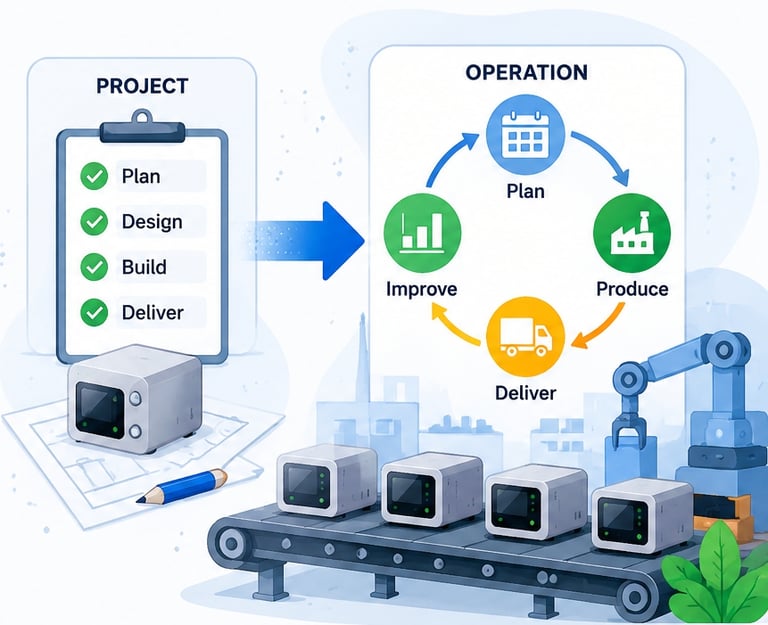
The project mode of Stage 1–3 and the operation mode of Stage 4 require different things from the manufacturing relationship — and different things from you as the product owner.
THE PRODUCTION CYCLE
How ongoing production works — five phases, repeating
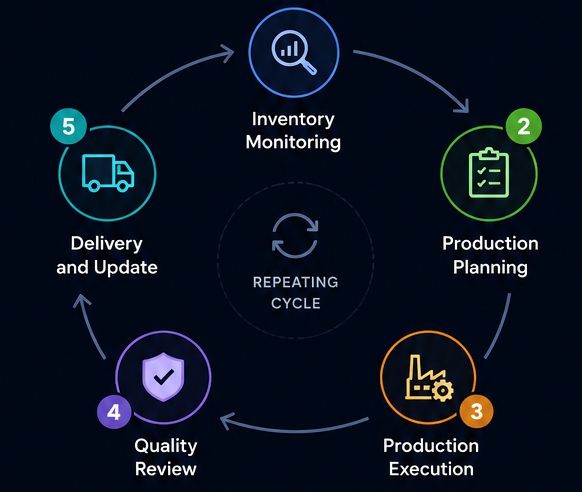
Each production cycle follows the same five phases — monitoring, planning, execution, quality review, and delivery. The cycle repeats on a cadence determined by demand and inventory levels. Each cycle is an opportunity to improve on the previous one.
The production cycle repeats. Each cycle improves on the last. Here is how the economics change as volume grows.
Inventory monitoring
①
Track inventory levels, orders in process, and sales demands.

Goal: Know when to start the next production run.
②
③
④
⑤

Production planning
Confirm demand, check materials, and create production plan.
Goal: Produce on time with consistent quality.
Production execution
Source materials and manufacture the products.
Goal: Prepare everything before production starts.

Goal: Ensure quality and improve for next time.
Inspect samples, review results, and address any issues.
Quality review
Goal: Deliver to customers and prepare for the next cycle.
Ship products, update records, and close the cycle.
Delivery and update


About the Cycle
The cycle repeats on a cadence set by demand and inventory levels. Very cycle gives you data and experience to do it better next time.
Phases 1 + 3 overlap — monitoring never stops. Inventory depletes DURING production run. Safety stock must cover full cycle duration from trigger to delivery. Otherwise: permanent stockout pattern.
Quality and cost compound across cycles. 95% FPY run 1 → 97.5%+ by run 4. $46.80/unit → $28–32/unit. Systematic review + deliberate improvement + growing volume. Achievable within first year for products with active quality cycle.
SCALING ECONOMICS
How unit costs change as production volume grows
Unit cost reduction at scale isn't automatic — it's the result of four specific mechanisms, each activated by a specific decision. Understanding the mechanisms tells you which decisions matter and when to make them.
FOUR COST REDUCTION LEVERS
Scaling economics are one part of launching successfully. Here are the market launch considerations that affect production planning.




CUMULATIVE PRODUCTION VOLUME (UNITS)


THE UNIT COST CURVE
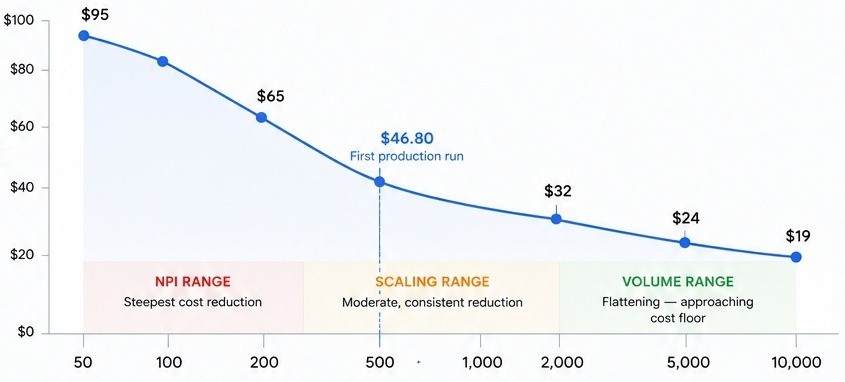
PER-UNIT MANUFACTURING COST (UNITS)
Process efficiency improvements
Faster processes and less waste reduce cost per unit.
Better component pricing
Higher volumes unlock lower prices from suppliers.
Overhead absorption
Fixed costs spread over more units, lowering cost.
Tooling and investment
Upfront investment enables lower long-term unit cost.


Costs fall as volume grows - fastest in the early stages, then slower. Each lever helps you move to the next, lower cost tier.
What matters at launch — beyond manufacturing, but connected to it
Certification, packaging, fulfillment, and sales channel each have specific implications for how your production is planned. None of these are things Peakingtech does for you — but all of them are things Peakingtech's production planning needs to account for.
MARKET LAUNCH CONSIDERATIONS
Product Certification


Packaging and Unboxing
Scope boundary
These topics are outside Peakingtech’s core services. Our role is to plan and produce with your market launch needs in mind.
WHAT PEAKINGTECH DOES
We build certified samples, lock the BOM for certified products, and check any changes against your certified configuration.
Most markets require certification (FCC, CE, UKCA, etc.) Testing is done by a third-party lab on a specific product configuration. Any change may require re-testing.
Packaging design is your decision. But packaging materials and assembly are part of manufacturing. Packaging is the final step in the box-build process.
WHAT PEAKINGTECH DOES
We source and produce packaging materials, including them in assembly, and inspect packaging quality with the product.


WHAT PEAKINGTECH DOES
We deliver production on time, package for shipping, and share dimensions, weights, and pack quantities to support your logistics.
Shipping, warehousing, and inventory strategy affect lead times and cost. Planning for fulfillment early helps avoid delays and extra expenses.
Fulfillment Logistics

WHAT PEAKINGTECH DOES
We follow your channel requirements for labelling and documentation and deliver in the format needed for your channel.
Requirements vary by channel (Amazon, retail, distributors). They impact labelling, documentation, and how products are delivered.

Sales Channel Considerations
Ready to launch and scale?
Whether your first production run has just shipped or you're evaluating Peakingtech as a long-term manufacturing partner before you start, tell us about your production goals — we'll respond with how an ongoing partnership would work for your specific product.
START STAGE FOUR
Long-term partnership · Fixed-price production runs · Dedicated account management
What happens next
1.We We learn about your product and stage
A member of our production team reads your submission and, if you're an existing client, reviews your production and quality history. If you're evaluating Peakingtech before starting, we'll ask a few clarifying questions to understand your product and timeline.
2.We outline how the partnership works for you
Within 48 hours: a response covering production cycle cadence, what an ongoing reorder relationship would look like for your specific volume and product, and — if relevant — a unit economics outlook for your expected scaling path.
3.We assign a dedicated point of contact
Ongoing production relationships are managed by a consistent point of contact who knows your product, your BOM, and your production history — not a new project manager for every cycle.


Previous Stage:
← Prototype to Production
SERVICES
Peakingtech © 2025. · Shenzhen, China · Privacy Policy · Terms of Service
Contact Form
Metal Parts


Peakingtech® is a registered trademark of Peakingtech Co in the United States.
COMPANY
CONTACT