WHY WE EXIST
Why we started — and who we built this for
Most contract manufacturers in Shenzhen are built for established brands. They are optimized for volume — minimum order quantities in the hundreds or thousands, production lines that run most efficiently when the product doesn't change between cycles, and account managers whose job is to process repeat orders rather than develop new ones. That model works well for companies that have already figured out their product. It works poorly for the founders who are still in the process of figuring it out.
Hardware founders have a different set of needs. They need a manufacturer who will look at their design and tell them honestly what's wrong with it before the tooling is cut — not after. They need someone who can build five units for a pilot and then five thousand units for a launch, without treating the prototype stage as a distraction from the real work. They need English communication that doesn't require a translator's translator — not formal written updates that obscure problems in polite language, but direct conversation about what is actually happening on the factory floor.
We built Peakingtech because we had seen what happened when hardware founders tried to navigate Shenzhen's manufacturing ecosystem without a partner who was specifically built for their stage. Designs that went to production with DFM problems that a thirty-minute review would have caught. Prototypes that were never built because the minimum order quantity was ten times what the founder needed. Supply chains that were sourced from grey market distributors because the founder didn't know to ask about authorized sourcing. Certifications that were planned for the wrong configuration. Schedules that slipped because long-lead components weren't identified until the week before production was supposed to start.
We are not the right manufacturer for every product. We are specifically built for hardware founders and small product brands bringing new products to market.
We are not the right manufacturer for every product. We are specifically built for hardware founders and small product brands bringing new products to market — products that need careful design review before a single tool is cut, prototype builds from quantities that most manufacturers won't touch, and a manufacturing partner who treats the NPI stage as the investment it actually is rather than the obstacle it appears to be when you're optimized for volume production.
What that means in practice: we take on projects at the idea stage, not just the ready-to-produce stage. We tell founders what we see in their design, including the parts they probably don't want to hear about. We build prototypes from five units when the design is ready to be tested and ten thousand units when the market is ready to be served. We price honestly before we start, not after we finish. And we manage the communication in plain English — not translated Chinese manufacturing updates, but direct conversation between the people working on your product and the person whose product it is.
Ethan and the engineering team at Peakingtech have run these processes across dozens of NPI projects — consumer electronics, industrial sensors, IoT devices, audio equipment, medical-adjacent hardware, smart home products. Not every project has been straightforward. Some prototypes needed three revision cycles before production authorization. Some supply chains turned up long-lead components that pushed schedules by weeks. Some DFM reviews produced lists of findings that required significant design rework. The projects that went smoothly went smoothly because of process, not luck. The projects that hit problems hit problems that were identified early enough to be manageable — which is the most honest thing we can say about what good manufacturing partnership actually delivers.
WHAT WE BELIEVE
What we believe about working with hardware founders
Six things — not a values statement, not a mission, but specific positions on how we work and why. We hold these because we have seen what happens when they are absent.
01- We tell founders what we see in their design, even when it's uncomfortable
The most valuable thing a manufacturing partner can do at the design stage is be honest about what they see. A DFM review that tells you everything is fine when it isn't is worse than no DFM review at all — it provides false assurance and sends a design into tooling that will produce problems in the build. We have a standing commitment to share every finding we identify in a design review, classified by severity, with specific proposed resolutions. Some of those findings will be things you were hoping we wouldn't notice. We notice them. We tell you. That is the job.
02- You own everything — design files, tooling, and all the IP we work on together
When Peakingtech produces a design, that design belongs to you. When Peakingtech cuts tooling, that tooling belongs to you from the moment it is paid for. If you decide to move production elsewhere, you take everything with you — the files, the drawings, the tooling, the supplier relationships we established for your BOM. We operate under NDA as a matter of course, not as a special accommodation. We believe this position is the only commercially honest one for a manufacturing partner to hold: the work was done for your product, in service of your vision, and the assets it produced are yours.
03-Fixed price before we start — not a bill that grows as we discover what was missed
Every project at Peakingtech is quoted at a fixed price before any work begins. The number in the project brief is the number on the invoice. We do not charge for DFM findings that require design revision — if the revision was needed because of something we missed in the initial review, that is our oversight to correct. We do charge for scope changes that represent new work beyond the agreed project brief, handled through a formal change order process that you approve before the additional work begins. The principle: you should know what this is going to cost before you commit to it, and surprises on invoices are a sign of poor scoping, not of unavoidable complexity.
04- English project management means the project manager speaks English — not someone translates updates
There is a specific kind of frustration that hardware founders who have worked with Shenzhen manufacturers know: receiving a weekly update that has been translated from Chinese into technically correct but contextually empty English. "Production is proceeding according to schedule" in a week when production has, in fact, encountered a significant component availability problem. The translation is accurate. The communication is absent. At Peakingtech, the person managing your project communicates directly with you in English — not as a translation layer on top of a Chinese project, but as the actual owner of your project's timeline and outcome. When there is a problem, you hear about it in the same conversation where it is first identified, not in a formal written update two weeks later.
05- NPI from five units means we are genuinely set up for it — not that we will do it reluctantly
Saying you can build five units and being built to build five units are different things. A manufacturer optimized for production runs finds small prototype builds disruptive — they pull resources from the production work that actually fills the line, they require more engineering oversight per unit, and the margin per build is thin relative to volume. We designed the NPI service to be a core offering, not an accommodation. The people who work on your five-unit prototype build are the same people who will work on your five-thousand-unit production run. The DFM rigor is the same. The documentation is the same. The communication is the same. We do not have a tiered service quality based on order size. We have a single standard, applied consistently from the first prototype to the hundredth production cycle.
06- We are your manufacturing partner, not your manufacturing department — and the difference matters
A manufacturing department is yours. It exists to serve your priorities exclusively, and it will do whatever you ask even when what you are asking is not the best approach. A manufacturing partner is separate from you. They bring independent judgment, they push back when they see a better way, and they tell you when the decision you are about to make will create a problem downstream. We are the second kind. We will execute your decisions when they are yours to make — design choices, commercial choices, timeline choices. We will also tell you, clearly and specifically, when we think a decision is going to cause a problem. The distinction matters because the founders who have the best manufacturing outcomes are the ones who have access to independent manufacturing judgment at every decision point, not just at the end when the problems become visible.
SHENZHEN
Why we're in Shenzhen — and what it actually means for your product
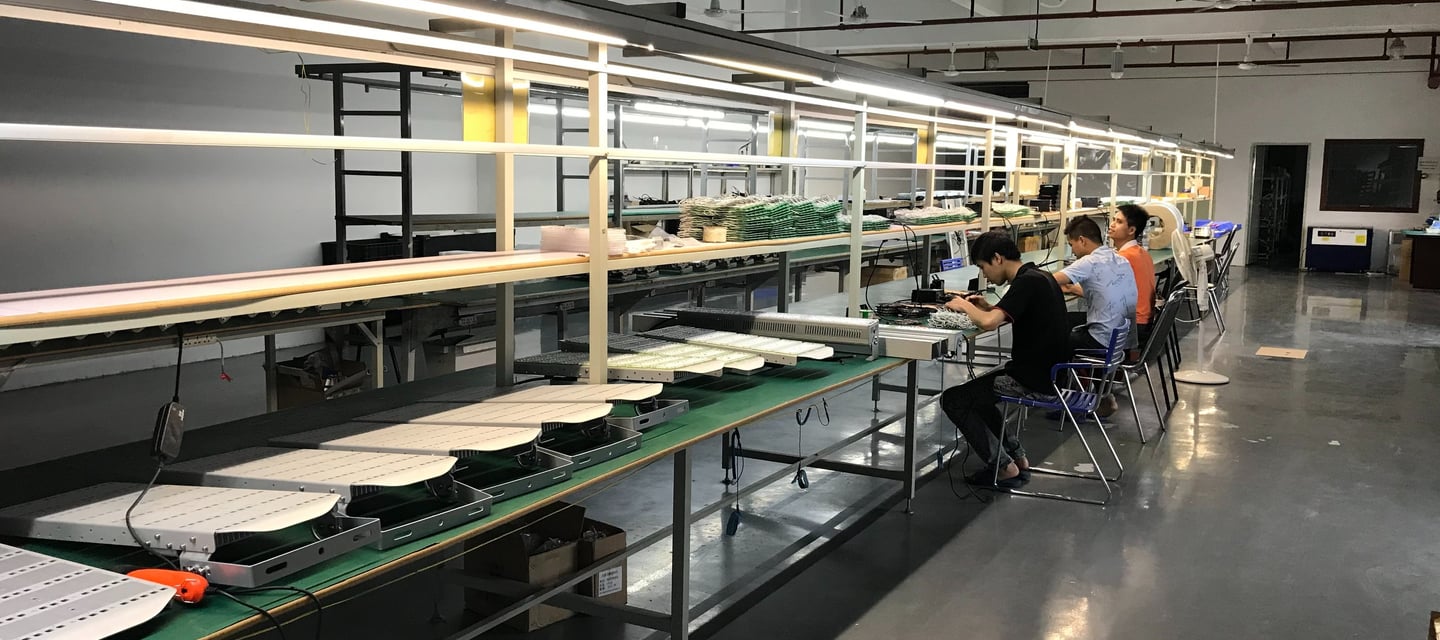
Shenzhen is where approximately thirty percent of the world's electronics are produced. That statistic gets cited often enough that it has stopped conveying anything concrete. What it actually means, in terms that affect a hardware product, is this: within a fifty-kilometre radius of our facility, there are authorised distributors for every major component manufacturer, tooling shops that can fabricate a prototype injection mould in two weeks, PCB fabricators with standard turnaround times measured in days, surface finishing operations for every metal and plastic process we use, and a concentration of manufacturing process knowledge that doesn't exist anywhere else on earth at this density. The geography is the capability.
The people behind the work
ADVANTAGE 01: Component lead times measured in days, not weeks
When your product is in production and a component supply issue arises — a distributor temporarily out of stock, a price spike from a specific supplier, a component that needs to be substituted at short notice — the practical consequence of being Shenzhen-based is that the problem can be resolved in hours rather than days. The authorised distributors we work with maintain physical warehouses within driving distance. Standard passive components, commodity logic, and most connectors are available same-day or next-day from Shenzhen stock. The same component ordered from a Western distributor involves international freight and customs clearance. For a production schedule that depends on all BOM components being available on a specific date, the difference between one day and three weeks is the difference between a production run that starts on schedule and one that doesn't.
ADVANTAGE 02: Supplier qualification visits that take a morning, not a trip
For custom components — a specific display module, a proprietary sensor, a custom battery pack — qualifying a supplier correctly requires a visit. You need to see the facility, meet the people who will build the component, review the quality system, and make a judgment about whether this is the right supplier for your product. From Shenzhen, that visit is a drive. From Europe or North America, it is an international flight, a hotel, and two days out of the calendar. The practical consequence is that Peakingtech qualifies suppliers for custom components with a rigour that is simply not economically viable for manufacturers who are not Shenzhen-based. We visit before we qualify, not just when there is a problem to investigate.
ADVANTAGE 03: BOM cost built on base pricing, not importer margins
Component pricing in the electronics industry has geography built into it. A passive component that a Shenzhen distributor sells at base pricing travels through additional margin layers — importer, regional distributor, local warehouse — before reaching a Western manufacturer's purchasing team. For a standard fifty-line BOM, the difference between Shenzhen distributor pricing and Western distributor pricing on passive components and commodity ICs typically runs between thirty and sixty percent of component cost. That is not a small number when components represent forty to sixty percent of a finished product's manufacturing cost. The BOM cost reduction that comes from Shenzhen-based sourcing is not a discount or a special arrangement — it is the absence of the margin layers that distance from manufacturing creates.
ADVANTAGE 04: Manufacturing process knowledge at walking distance
Some manufacturing problems are solved by thinking. Others are solved by asking someone who has solved the same problem thirty times before on a production floor two blocks away. The density of manufacturing expertise in Shenzhen — tooling engineers, materials specialists, surface finishing experts, SMT process engineers, injection moulding specialists — means that when a specific technical question arises on a project, the person who knows the answer is almost always reachable within a day. We use this density actively: design questions are sometimes resolved by walking a part to a tooling shop for an opinion, process questions by visiting a finishing operation that has run the same material on the same substrate a hundred times. The knowledge exists here in a way that cannot be replicated by research alone.
WHAT SHENZHEN IS NOT: An honest note on where the Shenzhen advantage applies — and where it doesn't
Shenzhen is not the lowest-cost manufacturing location for every product. For high-volume, labour-intensive assembly with minimal engineering complexity, some Southeast Asian manufacturing locations offer lower pure assembly costs. For products that use predominantly Western-manufactured specialty components — certain RF modules, specific certified sensors, proprietary display technologies — the BOM cost advantage of Shenzhen-based sourcing is smaller than it is for standard BOM compositions.
Shenzhen is also not immune to supply chain disruption. The 2020 to 2022 component shortage affected Shenzhen manufacturers as significantly as any other. Geographic proximity to component stock reduces the lead time to resolve a disruption, but it does not prevent disruption from occurring.
The Shenzhen advantage is most significant for hardware products with standard-to-moderate BOM complexity, prototype and NPI builds where design support and fast iteration matter, and ongoing production relationships where supply chain management benefits from physical proximity to the component ecosystem. For those products and those relationships, the advantage is real, material, and measurable. For others it may be smaller or absent. We say this not to qualify the case for working with us, but because a manufacturing partner who overstates their geographic advantage is also likely to overstate their other capabilities.
For the products we work on — hardware founders' first and second products, small brands scaling from prototype to production to sustained market presence — Shenzhen is not background information. It is the operational infrastructure that makes everything in the previous section possible. The fixed pricing, the fast iterations, the honest DFM, the direct communication — all of these are easier to deliver when the supply chain is next door, the manufacturing expertise is down the street, and the tooling shops know us by name.
The people behind the work


Joe - Founder · Project management and client relationships
Joe built Peakingtech from direct experience working in and around Shenzhen's electronics manufacturing ecosystem — not as an engineer who learned manufacturing from the outside but as someone who has spent years in the supply chain, the tooling shops, and the factory floor. He has run NPI projects from initial design brief through prototype build, revision cycle, production authorization, and first production run across a range of product categories: consumer electronics, industrial sensors, IoT devices, audio products, and hardware accessories. He understands what hardware founders are trying to accomplish because he has worked alongside hardware founders at every stage of the process.
On a Peakingtech project, Joe is the person you will talk to. Not as a sales contact or an account manager, but as the project owner — the person who has read your design brief, reviewed your DFM findings, attended the prototype evaluation, and knows the current status of your production run at any given moment. When something goes wrong — and at some point on most projects, something does go wrong — Joe is the person who tells you directly, explains what happened, and has already started working on the resolution before the conversation ends.
THE TEAM
AN HONEST NOTE: What the team is not
We are a focused NPI and contract manufacturing operation, not a large-scale contract manufacturer with hundreds of engineers and a global logistics network. We work with hardware founders and small product brands — that focus is a choice, and it means there are projects that are not the right fit for us. Very high-volume production runs (above ten thousand units per cycle), products requiring Class 3 high-reliability assembly as a default, and products that need a large onsite engineering team available for embedded development work are better served by manufacturers with different capabilities. We say this not to pre-emptively disqualify enquiries but because a founder who contacts the wrong manufacturer wastes their time on both sides. If you are not sure whether we are the right fit for your specific project, the fastest way to find out is to tell us what you are building.
The broader team
The engineering and manufacturing team at Peakingtech covers the functions that a hardware product needs across its development and production lifecycle — electronics engineering and PCB design, mechanical and enclosure engineering, injection moulding process management, sheet metal and CNC machining coordination, SMT assembly and quality management, and supply chain and sourcing. These are people who have each spent years on specific manufacturing disciplines in Shenzhen — not generalists who cover every function adequately, but specialists who cover their specific function well.
What this means in practice: your PCB design goes to someone who has laid out dozens of PCBs with similar constraints. Your enclosure DFM review is done by someone who has cut tooling for hundreds of injection-moulded parts. Your BOM is sourced by someone who knows the Shenzhen distributor landscape for your specific component mix from years of sourcing in that specific market. The experience is genuine and it is current — Shenzhen's manufacturing ecosystem changes fast enough that experience from a decade ago is often less valuable than experience from last year.
Start a conversation
Tell us what you're building — we'll tell you honestly whether we're the right fit and what working together would look like.
GET IN TOUCH
No commitment required · Response within a few hours · NDA available
SERVICES
Peakingtech © 2025. · Shenzhen, China · Privacy Policy · Terms of Service
Contact Form
Metal Parts

Peakingtech® is a registered trademark of Peakingtech Co in the United States.
COMPANY
CONTACT