
The Great MLCC Squeeze: Why Capacitor Prices Are Exploding in 2026 — and What Purchasing Managers Need to Do Now
Ceramic capacitor prices are spiking hard in 2026 — some high-capacitance MLCCs up 5–10x, with lead times stretching past 20 weeks. Unlike 2018's short-lived shock, this is a structural shift driven by AI server demand. This article breaks down the real cause, forecasts where prices go next, and gives purchasing managers and project deciders concrete steps to protect their BOMs and production schedules.
SOURCING & SUPPLY CHAIN
7/1/20266 min read
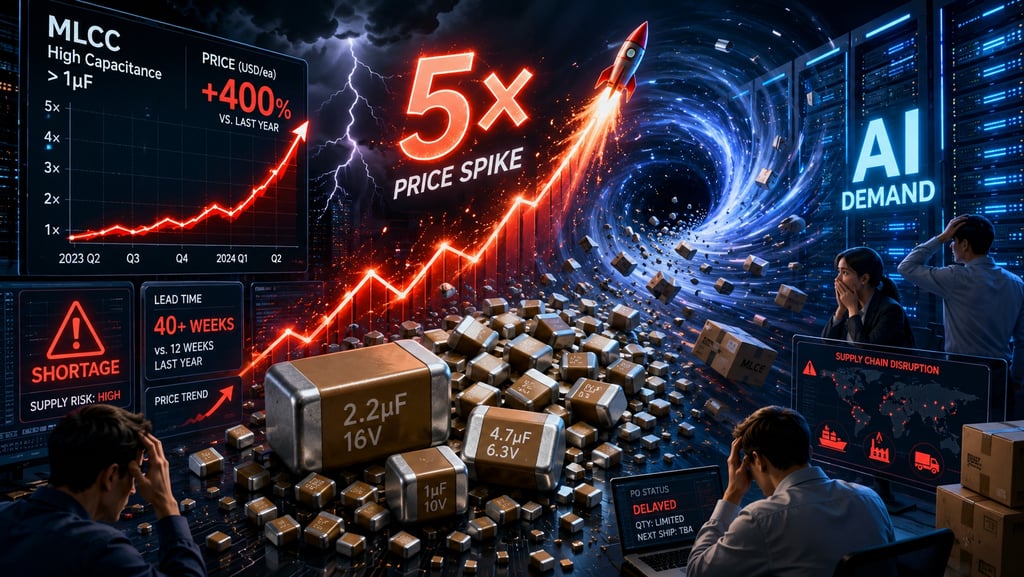
If you've placed a component order recently and choked on the quote for a high-capacitance ceramic capacitor, you're not imagining it. Since Chinese New Year 2026, spot prices for high-capacitance (>1μF) MLCCs have jumped anywhere from 2x to 10x depending on the specification, and lead times for high-end parts have stretched past 20 weeks. This isn't a routine cyclical blip — it's a structural repricing of one of the most basic building blocks in electronics, and it will reshape how every hardware company plans its BOM, its inventory, and its supplier relationships for the next 12–18 months.
This article breaks down why it's happening, where prices are headed, and — most importantly — what purchasing managers and project deciders should actually do about it.
What's Actually Happening
A few data points to anchor the discussion:
Spot prices for most high-capacitance MLCC models have doubled month-over-month since April 2026, with scarce specifications up 3–5x and a handful of extreme cases up 8–10x.
AI-server-specific high-capacitance parts (10–20μF class) have seen average increases around 50% just since late May, while ordinary standard MLCCs are up 15–20%.
Lead times for high-end MLCCs have extended from a normal 8 weeks to over 20–24 weeks.
Major suppliers — Murata, Samsung Electro-Mechanics (Semco), Taiyo Yuden, Yageo, Walsin, Fenghua — have all announced or are weighing double-digit price hikes through 2026, on top of tantalum capacitor increases of 15–30% from Panasonic that are pushing even more demand onto MLCCs as substitutes.
Silver, which makes up roughly 42–58% of MLCC production cost, hit record highs in early 2026, and nickel powder costs have also spiked after Indonesia cut nickel ore exports by two-thirds.
This is happening across the entire supply chain simultaneously — raw materials, manufacturing capacity, and channel inventory — which is exactly why it doesn't feel like a normal seasonal fluctuation.
Why This Time Is Structurally Different From 2018
Anyone who lived through the 2017–2018 MLCC shortage remembers it as sharp but short-lived — triggered by channel hoarding, a Japanese earthquake, and opportunistic Taiwanese price hikes. It rose fast and unwound just as fast. This cycle has different DNA, and understanding the difference matters for how long you should expect it to last.
1. Demand is structural, not speculative — driven by AI hardware architecture itself. AI accelerators run extremely hot (often over 100°C near the die) and extremely dense. Traditional aluminum electrolytic and tantalum capacitors don't hold up thermally or spatially, so designers are actively re-engineering BOMs to replace them with high-temperature-rated MLCCs (X6S series, rated to 105°C). This isn't a temporary allocation problem — it's a permanent change in how much MLCC each board needs. AMD's next-generation accelerator platform reportedly increased consumption of one specific 47μF MLCC spec from 1,440 to 10,544 pieces per board — a 632% jump — purely from BOM redesign, not volume growth. NVIDIA's Vera Rubin platform saw a >50% increase in a comparable high-capacitance spec. A single modern AI server can now consume up to 440,000 MLCCs — 10–15x a traditional server. When NVIDIA and AMD ship millions of accelerators a year, that per-unit multiplier turns into enormous absolute demand.
2. Capacity cannot respond quickly, and new entrants are structurally locked out. MLCC manufacturing — precision ceramic powder formulation, multilayer stacking, sintering — is capital-intensive with long qualification cycles, especially for high-reliability and automotive-grade parts. The capacity expansions that are underway (Samsung's Philippines plant, Tianjin conversion, Taiyo Yuden's Korean server-capacity line) aren't expected to meaningfully land until 2027. That means the supply side is essentially fixed for the next several quarters, no matter how high prices go.
3. The market has bifurcated into a "scissors spread." This is the detail many buyers miss: it's not that "MLCCs" are expensive — it's that the high-end, high-capacitance segment is in a genuine supercycle, while general-purpose, low-capacitance MLCCs (0402/0201, X5R/X7R below 1μF) remain a competitive buyer's market with flat-to-soft pricing. Suppliers are deliberately shifting capacity upmarket toward AI/automotive-grade parts, which is exactly why your >1μF line items are getting hit 5x harder than the rest of your BOM.
4. Raw material inflation is compounding the capacity story. Silver and nickel price spikes are adding real cost-side pressure on top of the demand-side story, meaning even if AI demand cooled tomorrow, some of this price increase wouldn't fully reverse.
5. The channel is whipsawing from "zero inventory" to panic restocking. After a four-year destocking cycle (2022–early 2026) where distributors ran lean, the moment AI server orders and EV demand signaled an inflection point, distributors flipped to aggressive hoarding — particularly of scarce, high-value, high-capacitance parts. That behavioral shift amplified the spot price spike well beyond what underlying supply-demand alone would explain.
Price Trend Forecast
Short term (Q3 2026, next 1–3 months): Expect continued upward pressure. Industry consensus points to another 20–30% increase on high-capacitance parts and 10–20% on mid/low-end parts, with spot prices for the scarcest specs remaining volatile and allocation-driven rather than list-price-driven. Don't expect a plateau yet.
Mid term (through 1H 2027): The supply-demand gap for high-end, high-capacitance MLCCs is unlikely to meaningfully close until new capacity from Samsung, Taiyo Yuden, and others comes online — realistically Q4 2026 at the earliest for partial relief, with full effect more likely in 2027. Expect the high-end segment to stay firm or keep climbing through this window, while general-purpose/low-cap parts stay comparatively stable or even soften slightly in off-peak periods.
Long term (2027 and beyond): This is the part purchasing managers should internalize: even analysts describing this as history's largest MLCC cycle (Goldman Sachs among them) don't expect a full reversion to pre-2026 pricing for high-end parts. The industry is settling into a permanently bifurcated structure — commoditized general-purpose MLCCs staying cheap and competitive, while premium high-capacitance, high-temperature, high-reliability parts carry a structurally higher price floor driven by technology barriers and sustained AI/EV/automotive demand. Think of it less as "a spike that will pass" and more as "a repricing of a specific product tier that will persist."
Key uncertainty: The entire forecast is contingent on AI infrastructure capex continuing at its current pace. Any meaningful slowdown in hyperscaler AI server buildout would soften high-end MLCC demand faster than most other scenarios in this forecast — worth watching as a leading indicator, but not something to plan your sourcing strategy around in the near term given current order visibility.
What Purchasing Managers and Project Deciders Should Do Now
1. Separate your BOM into "at-risk" and "safe" line items immediately. Any capacitor above 1μF, especially X5R/X7R/X6S in automotive or high-temperature grades, is at-risk. Sub-1μF general-purpose parts are largely safe. Don't apply blanket hedging — it wastes cash and negotiating leverage. Triage first.
2. Lock in allocation agreements, not just purchase orders. In an allocation-driven market, a PO without a supply agreement is just a request. Prioritize longer-term agreements with primary manufacturers or authorized distributors that guarantee volume allocation, even at a price premium. Buyers without allocation agreements are the ones facing 20+ week lead times and the worst spot pricing.
3. Build strategic buffer inventory for scarce, high-value specs — deliberately, not reactively. The channel's swing from zero-inventory to panic-buying is itself a major driver of the spike. Don't add fuel to it by panic-buying at the peak, but do build a deliberate 2–3 month buffer for your top 10–20 highest-risk part numbers, sourced through qualified, professional distributors rather than opportunistic spot-market channels.
4. Push your engineering team on qualification of second sources now — before you need them. Chinese manufacturers (Sanhuan Group, Fenghua Hi-Tech) are moving up the technology curve and gaining ground in mid-to-high capacitance segments as Japanese/Korean leaders shift focus further upmarket. Qualification cycles for alternate sources take months — start now, not when your primary supplier tells you they're out of allocation.
5. Get your BOM re-reviewed for substitution opportunities, not just new sourcing. Where a design doesn't strictly require MLCC-grade thermal/ESR performance, evaluate whether tantalum, polymer, or electrolytic alternatives are viable — even though tantalum has its own price pressure right now, a mixed strategy reduces single-point exposure. This is an engineering conversation, not just a procurement one — loop in design early.
6. Reprice contracts and quotes with realistic cost escalation clauses. If you're quoting NPI or production pricing to your own customers right now, don't lock in flat capacitor cost assumptions for a 12-month program. Build in indexed pass-through language tied to published MLCC pricing trends, or you will eat margin for the life of the program.
7. Extend your planning horizon and order earlier than feels comfortable. With lead times at 20+ weeks for high-end parts, sourcing decisions for Q1 2027 production need to be made now, not next quarter. Treat MLCC lead time the way you'd treat a custom ASIC lead time — it deserves that level of forward planning today.
8. Reassess new product designs at the BOM level before tape-out/DFM freeze. If you're mid-design on a new product, this is the moment to question every >1μF ceramic cap on the schematic: is this value actually necessary, or is it a legacy safety margin from a prior design? Every microfarad you can trim now is real cost avoided for the life of the product.
Bottom Line
This cycle is being driven by a genuine, multi-year structural shift in how AI hardware consumes passive components — not a short-term supply hiccup. Purchasing managers who treat this like 2018 (wait it out, absorb the spike, move on) will get burned on lead times and margin. The winning posture is active: triage your BOM by risk, lock in allocation rather than relying on spot buys, qualify second sources now, and build cost escalation into every quote you send out for the next several quarters. The companies that treat MLCC sourcing with the same seriousness as semiconductor allocation will be the ones still shipping on schedule in early 2027.
Sources: TrendForce, SCMP, Digitimes, Goldman Sachs research notes, Citrini Research, and industry distributor reporting, June–July 2026.
SERVICES
Peakingtech © 2025. · Shenzhen, China · Privacy Policy · Terms of Service
Contact Form
Metal Parts


Peakingtech® is a registered trademark of Peakingtech Co in the United States.
COMPANY
CONTACT