
Why Your Lithium Battery Dies Early: Discharge Rate, Pulse Load & Temperature
Shorter runtime, overheating, and weak cold-weather performance usually trace back to one spec: discharge rate. Learn how C-rate, pulse loads, and temperature quietly kill lithium batteries — and how to pick the right cell for your product.
DESIGN TO PROTOTYPE
Engineering Team
7/25/202612 min read
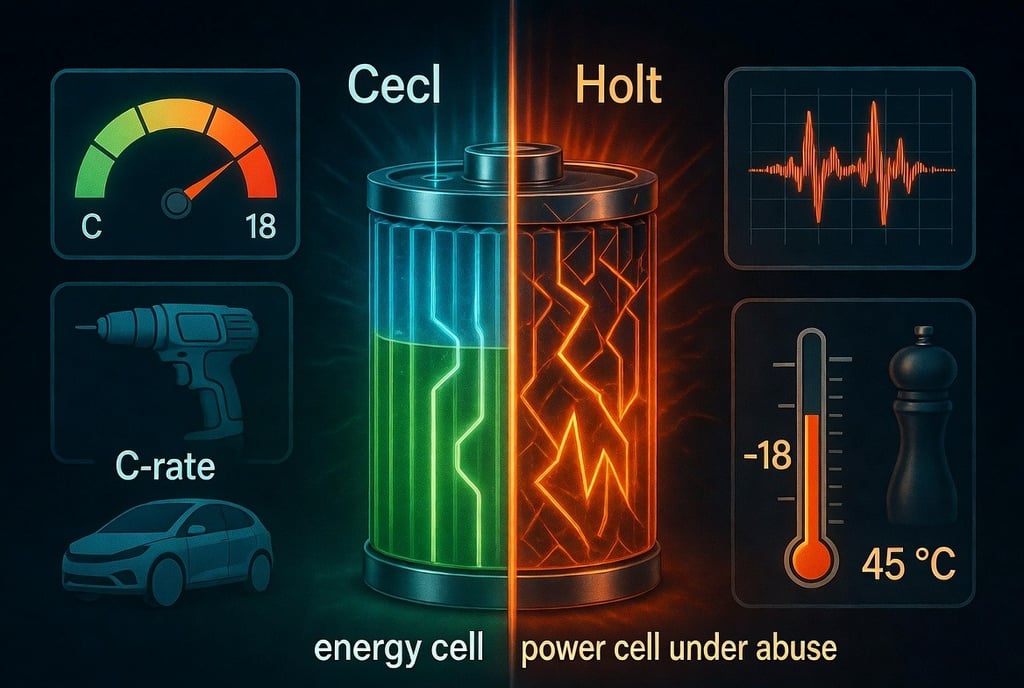
Your product's battery passed every bench test. The datasheet promised 2,000 mAh and 500 cycles. Yet six months after launch, customers are complaining that runtime has collapsed, the device gets warm in the hand, and in winter it barely works at all. The cells aren't defective. The charger isn't broken. In most of these cases, the real culprit is a spec that many teams treat as an afterthought: the discharge rate, and how it interacts with your device's actual load profile and operating temperature.
Most articles about lithium batteries will tell you what "1C" means and stop there. That definition is the easy part. What actually determines whether your battery lives a long, quiet life or dies an early, hot death is the relationship between three things: the C-rate the cell was designed for, the shape of the current your device draws (steady versus pulsed), and the temperature at which it all happens. Get any one of those wrong at the design stage, and no amount of firmware tuning will save you later.
This article walks through all three — and then does something most C-rate explainers skip entirely: it translates the theory into concrete selection guidance for real device classes, from consumer gadgets to power tools to EV packs, including a case from our own manufacturing floor.
C-Rate in Sixty Seconds
The discharge rate of a lithium battery is expressed as a C value: the ratio of discharge current to rated capacity. A 10 Ah cell discharged at 1C delivers 10 A. Discharge the same cell at 5C and the current jumps to 50 A. That's the whole definition.
In practice, cells fall into three broad families:
Low-rate cells (≤1C, typically 0.2C–0.5C): built for endurance — energy storage systems, backup power, anything that sips current for hours.
Mid-rate cells (1C–5C): the workhorse middle ground covering most consumer and industrial electronics.
High-rate cells (≥5C, with 10C, 20C, and beyond available): built for burst power — drones, RC racing, power tools, engine starters.
Here's the part the simple definition hides: these are not the same cell with different labels. A high-rate cell and a low-rate cell of identical capacity are physically different products, engineered from the electrode up for opposite priorities. Understanding that difference is the key to everything that follows.
Energy Cells vs. Power Cells: Two Different Machines
The lithium-ion industry has effectively split into two design philosophies, often called the Energy Cell and the Power Cell.
The high-rate (power) cell is built for current delivery. Its electrode plates are thin and porous, which increases conductive surface area and dramatically shortens the distance lithium ions must travel during discharge. Manufacturers load the electrodes with conductive additives — carbon nanotubes, graphene — that act like express lanes for electrons, driving internal resistance down to the milliohm range. The electrolyte carries a high lithium-salt concentration for fast ion transport, and the tabs (the current-carrying connections) are larger and more numerous, so heavy currents can flow without creating hot spots. Every one of those choices trades away energy density to buy power density.
The low-rate (energy) cell makes the opposite trade. Its electrodes are thick, packing in as much active material as possible to maximize capacity. Chemistries like lithium iron phosphate (LiFePO4) and NMC in high-capacity formulations dominate here. The design goal is long cycle life and low cost per watt-hour — not the ability to dump current on demand.
The performance gap between the two is not subtle. An energy cell typically stores on the order of 50% more capacity than a power cell of the same size, but its load must be kept modest. A power cell running at its maximum permissible discharge current will heat to around 50°C, with 60°C as the practical ceiling before protection circuitry should intervene. Meanwhile, internal resistance can differ by an order of magnitude: milliohms for a well-designed power cell versus tens of milliohms for an energy cell — which is exactly why forcing an energy cell to deliver power-cell currents ends badly.
There's a third option pack designers sometimes forget: use energy cells but oversize the pack, so each individual cell sees only a gentle fraction of the total load. This is famously the Tesla approach — thousands of energy cells sharing the burden, delivering exceptional range at the cost of weight and price. It's a legitimate engineering strategy, but only when your product can absorb the size and cost penalty.
Why Discharge Rate Quietly Kills Cycle Life
Every discharge cycle stresses a lithium cell, but the amount of stress scales sharply — not linearly — with current. During heavy discharge, lithium ions are ripped out of the electrode lattice at high speed. The active material particles expand and contract violently with each cycle, developing micro-cracks. The electrolyte decomposes faster at the elevated temperatures that heavy currents produce. Internal resistance creeps up, which generates even more heat at the same current, which accelerates degradation further. It's a feedback loop, and it only runs in one direction.
The numbers make the point brutally. Battery University's cycle testing shows that an Energy Cell discharged at 2C — just twice its comfortable rate — experiences far higher stress than at 1C, with the cycle count collapsing to roughly 450 cycles before capacity falls to half. The same class of cell, treated gently at low rates, can run for thousands of cycles. Nothing about the cell changed. Only the load did.
High-rate cells are engineered to tolerate this abuse better, but they don't escape the physics — they typically deliver 500 to 1,000 cycles even in their intended role, versus the 3,000 to 5,000 cycles a LiFePO4 energy cell can achieve under mild loads. When you choose a discharge rate, you are choosing a lifespan.
The Pulse Load Problem: Why "Average Current" Lies to You
Here is where many otherwise careful designs go wrong. Engineers calculate the average current draw of their device, check it against the cell's rated C-value, see comfortable margin, and move on. But batteries don't experience averages. They experience the instantaneous current, moment by moment — and most real devices draw current in pulses.
A wireless device bursts current during radio transmission. A motor draws a huge inrush spike at every startup — often five to seven times its running current. A digital load switches between sleep and full power thousands of times a day. On an oscilloscope, the current waveform of a typical modern device looks nothing like the smooth constant-current discharge used to generate the datasheet curves.
And batteries genuinely prefer the smooth version. In terms of longevity, a battery favors moderate, constant-current discharge over pulsed or momentary high loads. Battery University's load-condition testing shows cells delivering the most capacity and longest cycle life under gentle DC discharge, degrading progressively as the load becomes analog (variable) and then digital (pulsed) — a pattern that holds for lithium-ion just as it does for other chemistries. Each pulse forces the cell through a voltage sag as current rushes through the internal resistance; the sharper and heavier the pulse, the deeper the sag and the greater the localized stress on the electrodes.
There's a second, sneakier consequence: premature low-voltage cutoff. During a heavy pulse, the terminal voltage momentarily dips. If it dips below your device's undervoltage threshold, the system shuts down — even though the battery still holds plenty of charge. This is why a device can report "battery empty," rest for ten minutes, and then power on again with 20% remaining. The user experiences it as terrible runtime and flaky behavior. The root cause is a cell whose C-rating can't hold voltage under your pulse profile.
The design lesson: spec your battery to the peak, not the average. Characterize your device's worst-case pulse — amplitude, duration, and repetition rate — and make sure the cell can deliver that pulse while staying above your cutoff voltage at the end of discharge, at the lowest temperature you support. That last clause matters more than most people realize, which brings us to the third killer.
Temperature: The Multiplier on Everything
Temperature doesn't just affect lithium batteries — it multiplies every other effect discussed above, in both directions.
Heat is the aging accelerant. Heavy discharge generates heat; heat accelerates electrolyte decomposition and capacity fade; degraded cells have higher resistance and generate more heat at the same load. Operating a lithium cell at 30°C instead of a moderate room temperature cuts cycle life by roughly 20%. At 40°C the loss reaches about 40%, and cycling at 45°C can halve the life you'd get at 20°C. A high-rate cell working near its limits lives permanently in this danger zone, which is exactly why serious high-power packs — EVs, drones, e-bikes — invest in thermal management, from simple heat spreaders to full liquid cooling, and why anything above 60°C is treated as a hard protection threshold.
Cold is the performance thief. Low temperature slows the electrochemical reaction and drives internal resistance up. The practical result is startling: a battery that delivers 100% of its capacity at 27°C will typically deliver only about 50% at –18°C. That's not damage — the capacity mostly returns when the cell warms up — but for the user in a cold parking lot, the distinction is academic. Their device is dead.
Cold also amplifies the pulse-load problem viciously. Higher internal resistance means deeper voltage sag under every pulse, so devices hit low-voltage cutoff far earlier. Battery University specifically flags over-discharge under heavy load at low temperature as a major contributor to cordless power tool failures, and EV drivers know the winter-range penalty firsthand — partly cabin heating, but substantially the battery's own slowed chemistry.
One more cold-weather trap that destroys batteries permanently: charging below freezing. While discharge down to –20°C is generally tolerable, charging a standard lithium-ion cell below 0°C causes metallic lithium to plate onto the anode. The pack appears to charge normally, but the damage is permanent, and lithium-plated cells become more vulnerable to failure under vibration or stress. Any product destined for cold climates needs either a BMS that blocks sub-zero charging, a heating element, or a chemistry qualified for low-temperature charge.
This is why "rated capacity" on a datasheet is, frankly, a best-case number. It was measured at a comfortable temperature, at a gentle discharge rate, on a fresh cell. Your product will rarely enjoy all three conditions at once.
Application-Specific Guidance: Matching the Cell to the Job
Now for the part most C-rate articles never reach: what all of this means for your specific product category.
Consumer Electronics: Prioritize Runtime, Minimize Stress
For wearables, remotes, sensors, personal care devices, and most portable gadgets, the winning strategy is an energy-oriented cell run well below its rated discharge capability. If your device averages 0.3C with occasional 1C pulses, choose a cell rated for 2C–3C rather than one rated exactly at 1C. That headroom costs little, keeps voltage sag shallow during radio bursts and motor starts, keeps the cell cool, and can multiply cycle life. The user-visible payoff is a device that still holds most of its original runtime after two years instead of prompting "battery bad" reviews after one. Resist the temptation to spec the highest C-rate available "to be safe" — high-rate cells sacrifice the very capacity your runtime depends on.
Power Tools: Prioritize Current Delivery and Thermal Tolerance
Drills, saws, impact drivers, and outdoor power equipment live at the opposite extreme: brutal current spikes, stall conditions, high duty cycles, and users who work in unheated garages. Here, genuine power cells are non-negotiable. The pack needs low internal resistance to hold voltage through motor inrush, tabs and interconnects sized for sustained heavy current, and a BMS with fast over-current and over-temperature protection. Accept the trade-offs consciously: shorter cycle life (500–1,000 cycles is normal for hard-driven high-rate cells) and lower capacity per gram. And because cold-plus-heavy-load is the classic power tool killer, cell matching within the pack matters enormously — a single weak cell driven into reversal under a cold heavy load can take down the whole pack.
EV and Mobility Packs: Balance Everything, Then Manage It
Electric vehicles, e-bikes, and scooters can't pick a side — they need usable capacity for range, pulse capability for acceleration and regenerative braking, and longevity measured in years. The design space offers two broad paths: power-oriented cells sized closer to the actual load, or energy cells in an oversized pack where each cell sees only a gentle per-cell C-rate. Either way, the pack lives or dies by its management systems: thermal management to keep cells in their happy temperature window (including pre-heating in winter), and a BMS that limits both discharge pulses and regen charging pulses when the pack is cold. Buyers should also read range claims the way engineers read datasheets: the rated figure was measured warm and gentle, and winter reality will be meaningfully lower.
Cold-Environment Products: Design for Derated Reality
If your product ships to Norway, Canada, or a ski slope, design around the derated capacity, not the datasheet number. Practical rules: size the battery assuming roughly half capacity at –18°C; verify your pulse loads don't trigger premature cutoff at the minimum supported temperature; block charging below 0°C in the BMS or add heating; and consider low-temperature-optimized chemistries or electrolytes where the use case justifies the cost. Also set honest expectations in your marketing — "up to 10 hours" measured at 25°C becomes a customer-service problem in January.
A Case From Our Own Line: 6C Polymer Cells in a Kitchen Grinder
This isn't abstract for us. When Peakingtech developed the battery system for our electric pepper and salt grinders, the average current draw looked trivial on paper — a small motor, running a few seconds at a time. But the load profile told a different story: every grind is a motor start, and every motor start is an inrush pulse several times the running current, arriving against the mechanical resistance of hard peppercorns. Worse, grinders spend most of their lives idle on a countertop or dinner table, then must deliver full torque instantly, sometimes in a chilly kitchen. A standard 1C energy cell would have sagged badly under that inrush, tripping low-voltage cutoff and producing exactly the "it dies with charge remaining" behavior users hate. So we specified a 6C-rated lithium polymer cell instead. The generous rate headroom means the startup pulse barely dents the terminal voltage, the cell runs cool because it never operates near its limit, the grinder delivers consistent torque from a full charge down to the last few percent, and cycle life comfortably exceeds the product's service expectations. The cell costs slightly more than a commodity 1C part — and it eliminated an entire category of field complaints before the product ever shipped. That's the discharge-rate decision in miniature: a few cents of spec at the design stage, or a warranty problem later.
How to Get This Right in Your Own Product
If you take one process away from this article, make it this five-step sequence, in order:
Measure the real load profile. Put a current probe on a working prototype and capture peaks, pulse widths, and duty cycle — not just the average.
Define the temperature envelope. What's the coldest discharge and coldest charge your users will realistically attempt?
Choose the cell family. Energy cell, power cell, or oversized energy pack — based on the peak load, not the average.
Add rate headroom. A cell cruising at a third of its rated C-value runs cooler, sags less, and lasts dramatically longer than one running at its limit.
Protect and verify. Specify BMS thresholds (over-current, over-temperature, sub-zero charge lockout) against your real profile, then validate runtime and cycle life at temperature extremes — not just on a warm bench.
Discharge rate should also be matched with charge rate: high-rate cells generally support faster charging, which may itself be a product feature worth designing around.
Batteries don't die early by accident. They die early because somewhere in the design process, a pulse was averaged away, a temperature was assumed, or a C-rating was read as a marketing number instead of an engineering limit. Treat discharge rate as a first-class design decision, and your battery — and your customers — will quietly reward you for years.
Frequently Asked Questions
What does the C-rate of a lithium battery mean? C-rate is the ratio of discharge current to rated capacity. A 10 Ah battery discharged at 1C delivers 10 A; at 5C it delivers 50 A. Cells are broadly grouped as low-rate (≤1C), mid-rate (1C–5C), and high-rate (≥5C).
Why does my lithium battery die even though it shows charge remaining? Heavy pulse loads cause the terminal voltage to sag momentarily. If the sag crosses the device's low-voltage cutoff, the system shuts down early even with real capacity left. Cold temperatures make this worse by increasing internal resistance. The fix is a cell with more C-rate headroom for your pulse profile.
Is pulsed discharge worse for battery life than constant discharge? Yes. Batteries deliver the most capacity and longest cycle life under moderate constant-current discharge. Pulsed and heavy digital loads increase electrode stress and reduce both usable capacity and cycle count.
What's the difference between an energy cell and a power cell? An energy cell uses thick electrodes to maximize capacity (roughly 50% more than a comparable power cell) but must be discharged gently. A power cell uses thin, porous electrodes and conductive additives to achieve very low internal resistance for heavy currents, sacrificing capacity and some cycle life.
How much capacity does a lithium battery lose in cold weather? A cell delivering 100% capacity at 27°C typically delivers only about 50% at –18°C. The loss is mostly temporary, but heavy loads in the cold can also trigger premature shutdown. Never charge standard lithium-ion below 0°C — it causes permanent lithium plating damage.
How do I choose the right discharge rate for my product? Measure your device's peak pulse current (not the average), define your coldest operating temperature, and select a cell whose continuous and pulse C-ratings comfortably exceed the worst case. Cells running well below their rated C-value stay cooler and last far longer.
Peakingtech is a Shenzhen-based EMS and NPI partner helping hardware startups and product brands take designs from prototype to production — including battery selection, DFM, and full turnkey assembly. If you're specifying a battery for a new product, talk to us before you lock the BOM: peakingtech.com


SERVICES
Peakingtech © 2025. · Shenzhen, China · Privacy Policy · Terms of Service
Contact Form
Metal Parts


Peakingtech® is a registered trademark of Peakingtech Co in the United States.
COMPANY
CONTACT